How Rural Humour Travels from Field Talk to the Printed Page
Learn how rural humour changes between spoken tales and print, with a worked example for keeping a joke clear while preserving its local character.
How do you turn a rural joke told over a gate into a story that works on the page? Rural humour often depends on a concrete local detail—a lane, a noticeboard, a stubborn pump—so adapting it means deciding what a new audience needs to see and what can remain unsaid.
Rather than claiming a single historical route from harvest talk to print, it is more useful to treat oral and written versions as different creative forms. A spoken tale can breathe with pauses and replies; a printed one has to make those turns visible in words.
Spoken story material
In conversation, a teller can point towards a place, wait for recognition or let someone else supply a name. The story may change as people interrupt, correct a detail or add a familiar twist. Those responses are part of the occasion, not flaws to remove from a transcript.
For a written adaptation, begin by separating the story’s essential comic turn from the circumstances of its telling. Keep the reversal, misunderstanding or contrast that makes the tale work. Then decide how to convey gestures and shared context without pretending that speech can be copied exactly onto a page.
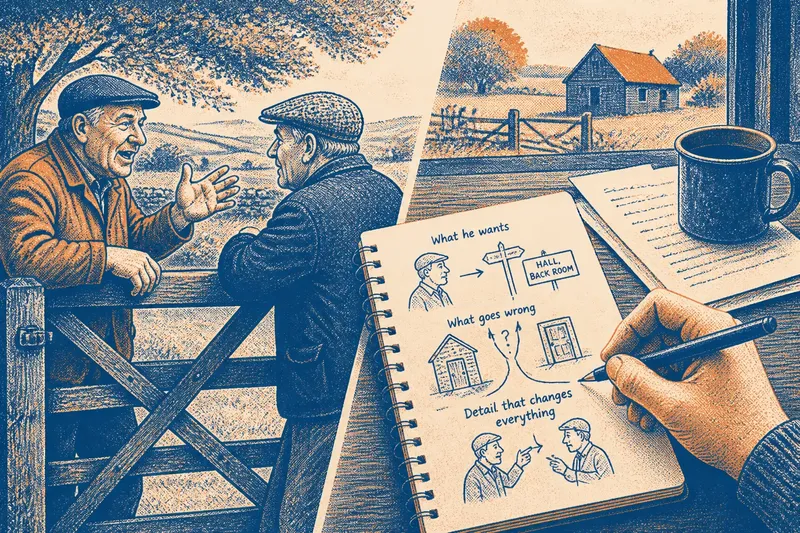
A useful note-taking method is to record the sequence rather than every spoken word: what the character wants, what goes wrong, and what detail changes the audience’s understanding. Add local names only when they help the scene; if a reference needs explanation, let an action reveal its relevance.
Write down the turn before polishing the teller’s phrasing.
Page-ready details
Print gives a writer room to arrange information, but it removes the audience’s immediate reactions. A reader cannot ask who owns the field or see the teller pause before the punchline. The prose must provide enough context to make the situation legible, without stopping to explain every custom.
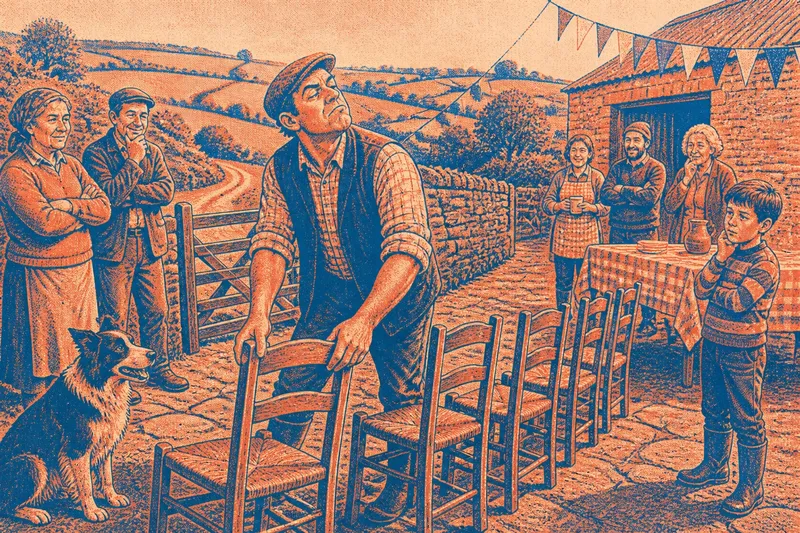
Concrete action is often more graceful than background exposition. A character can turn the wrong way at a sign, carry a folding chair into the wrong room or insist on a local name that another character misreads. Readers learn what matters by watching the consequences.
Read the draft aloud. If the sentence needs a gesture to make sense, add a brief description or rearrange the words. If an explanation arrives before the comic turn and drains its surprise, move it later or remove it.
Let the scene do the explaining wherever it can.
A worked adaptation
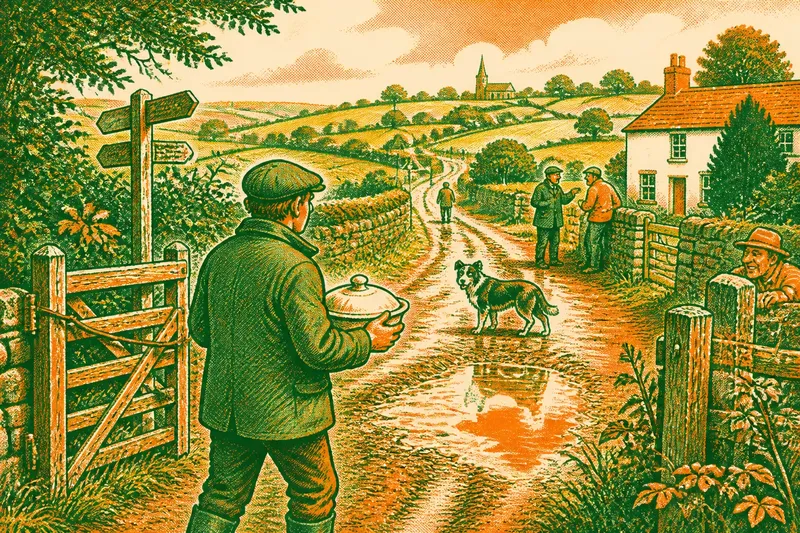
Say you have an invented spoken tale about a village notice that sends two neighbours to different rooms for the same meeting. The starting inputs are a notice reading “Hall, back room”, a neighbour who assumes “back” means the room behind the main hall, and another who understands it as the rear entrance. In the spoken telling, the teller pauses while listeners imagine both neighbours waiting; the action is to preserve that pause and the conflicting interpretations. For print, write each neighbour’s arrival in a separate short scene, then reveal the ambiguous wording. The expected observable result is that readers can identify the misunderstanding before the characters meet, while the final exchange still delivers the comic reversal. The trade-off is clear: the printed version makes the layout easier to follow, but gives up some of the live audience’s shared anticipation.
To adapt another tale, write its starting details in plain terms, choose what the reader must know, then read the revised scene aloud and check whether the turn remains clear.
Choosing a format
Choose a form by looking at what carries the joke and what you want the audience to do. Use this list to make a concrete decision:
- Observation: listeners need a pause, gesture or room-wide reaction to understand the turn. If so, tell it aloud; then use a brief stage direction or a new scene if adapting it for print.
- Observation: the joke depends on events arriving in a precise order. If so, draft it on the page; then read it aloud and reorder any details that give away the turn too early.
- Observation: local listeners understand a place-name without explanation. If so, keep it for a local telling; otherwise, add a clue through a character’s action or use a clearer description.
- Observation: the story changes each time someone adds a detail. If that variation is part of the pleasure, leave room for retelling; otherwise, select the detail that best serves the written version.
- Observation: readers cannot tell why two characters disagree. If the cause is missing, add a visible clue such as the wording on a sign; if the cause is already clear, cut the extra explanation.
- Observation: a transcript preserves words but loses the teller’s timing. If the pause matters, represent it with sentence breaks or action; otherwise, tighten the passage and let the next event carry the pace.
For a mixed approach, keep a stable written version as a starting point and leave room for a teller to adjust local details. That way the story can travel without requiring every performance to sound identical.
Questions about adaptation?
Can an oral story be printed word for word?
A transcript can preserve the wording, but it may not convey pauses, gestures or audience responses. Shape the page version around the action and comic turn rather than treating spoken conversation as a script.
How much local context should a story explain?
Explain only what readers need to follow the action. A character’s response to a place-name, custom or notice can often supply that context without a separate block of background.
What should stay the same in an adaptation?
Keep the source of the comic turn: perhaps a mistaken assumption, a reversal or a contrast between a grand plan and a modest setting. Other details can change if they help the new form make that turn clear.
Should a writer perform a draft aloud?
Yes, if the tale relies on rhythm or a spoken voice. Reading aloud can reveal a sentence that is hard to follow, a pause in the wrong place or an explanation that arrives too soon.
Letting stories travel
Rural humour does not need to be treated as a contest between an original telling and a lesser copy. Each form makes its own choices: conversation can welcome interruption, while print can guide a reader through a carefully arranged scene. An adaptation is strongest when it makes those choices deliberately.
When you search for rural humour and its movement between speech and print, focus on the craft rather than an unsupported historical claim: what is the comic turn, what context does the audience need, and which details should change with the medium? Keep a note of the source wording beside the edited version, especially when a place-name or local expression carries the joke. That small record makes later revisions easier without freezing the story into a single supposedly definitive form.