Why the Lane Matters in a Rural Tall Tale
Why the lane matters in a rural tall tale: shape obstacles, running jokes and a satisfying ending from a route your listeners can picture.
Why does a rural tall tale lose its comic spark when the journey feels like a line on a map? Often, the lane is doing too little. A familiar route gives the storyteller bends, gates, puddles and landmarks to turn into obstacles, recurring jokes and a natural build towards the ending.
That does not mean every tale needs a long walk or a catalogue of farmyard mishaps. The route works best when each encounter changes what the traveller expects, while the place remains easy to picture. If your story feels stalled, confusing or abruptly finished, the problem may lie in how the lane is being used.
Route without direction
A tale can start with a traveller setting out, then drift through incidents that feel interchangeable. The usual cause is a route with no comic destination beyond “the next place”. A listener may know the names of several local landmarks and still wonder why the traveller is passing them.
Give the journey a practical aim that can be made awkward: delivering a parcel before the shop closes, reaching a neighbour with a borrowed tool, or getting home before a cake cools. The goal need not be grand. It simply gives each delay something to push against.
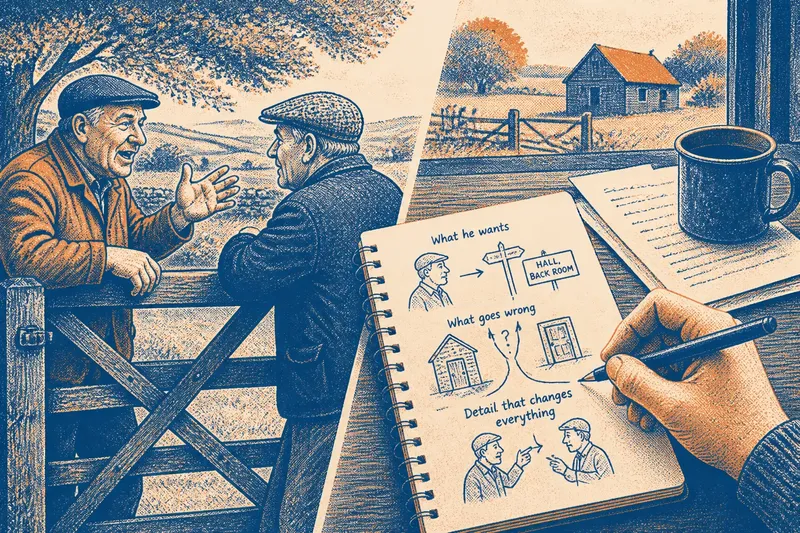
Sketch the route in a few plain points. A gate might interrupt progress, a bend might hide who is coming, and a familiar signpost might show how little distance the traveller has covered. Each point should affect the attempt, rather than serve as scenery alone.
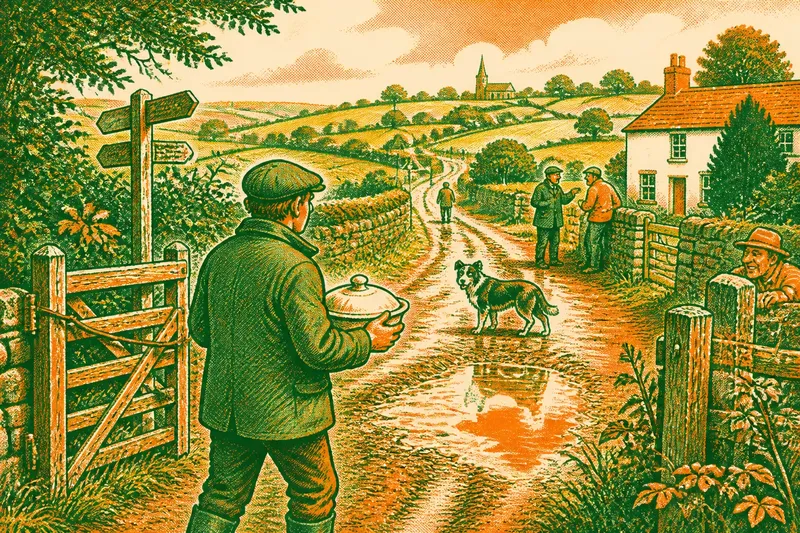
Say you are inventing a tale about a person carrying a covered bowl to a neighbour’s supper. The starting point is the person at the end of the lane with the bowl and a clear destination. At the first gate, a loose latch makes them stop and set the bowl down; farther on, the same awkward pause returns for a different reason. The expected result is a journey that feels delayed in a connected way, not a string of unrelated episodes.
Obstacles without variety
Repeated delays can create a satisfying rhythm, but several identical mishaps will make the story feel stuck. This often happens when every obstacle is just another thing in the way: a closed gate, then another closed gate, then a blocked track.
Keep the lane recognisable while changing what it asks of the traveller. One obstacle can be physical, such as a puddle across the track. Another can be social, such as stopping to answer a neighbour who has mistaken the parcel. A third can come from the traveller’s own assumption: they take a turning they know well, only to discover that it leads past the destination rather than towards it.
The variety should grow from the route. A narrow bridge can make haste unhelpful; a bend can make a harmless greeting sound like an argument; a gate can give an unwanted audience time to gather. A setting feels comic when its features shape the trouble, not when jokes are pasted onto a generic journey.
- Use a physical snag to slow the traveller.
- Use a local encounter to alter the plan.
- Use a mistaken assumption to make the traveller responsible for the next delay.
Choose obstacles that change the situation, not just the scenery.
Repetition without change
A recurring detail can become the story’s most memorable joke: a gate that never opens the first time, a dog that appears at every bend, or a sign the traveller keeps reading from the wrong side. The trouble begins when each return lands exactly like the last.
Let the repetition accumulate meaning. The first time, the gate is a minor nuisance. The next time, the traveller arrives carrying something that cannot be put down. Later, they may boast that they have mastered the latch, only to find someone watching as it swings open with a gentle push. The repeated detail now exposes changing confidence, not merely repeated bad luck.
Keep the pattern clear enough to recognise, then alter one part of it. The audience should be able to anticipate the return without knowing precisely what it will do. That small gap between expectation and result is where the joke can live.
Local details overloading
Writers who know a place well can crowd a tale with lane names, family references and private landmarks. The details may be vivid to the storyteller but leave a listener outside the joke. The cause is often a wish to prove the story belongs to the locality.
Keep details that help an outsider follow the action. “The gate beside the old orchard” gives a listener something to imagine and a feature that can affect the journey. A cluster of unexplained names may sound authentic, but it does not automatically create a comic scene.
One precise detail can do more than several decorative ones. A patch of mud that clings to a boot can become a problem at each stop; a familiar bend can make a late arrival seem to have taken the scenic route. Let the detail earn its place by changing movement, expectation or the way characters respond.
If a local reference matters to the humour, make its meaning clear through the action around it. A listener need not know the history of a lane to understand that everyone avoids one particular gate.
Ending before the build
A tall tale can reach its destination and still feel unfinished. This tends to happen when arrival is treated as the ending by itself, even though the route has been building a pattern that has not yet paid off.
Look back at the obstacles and repetitions. Which detail has gathered the most expectation? Bring that detail into the final encounter, but let it behave in a way that changes the meaning of the journey. The latch that defeated the traveller might open easily for the person they were hurrying to meet; the supposed shortcut might bring them back to the starting point just as the parcel is finally needed.
A satisfying ending does not need to explain the joke. It should make the route feel newly legible: the earlier delays now seem to have been pointing towards this particular turn. If the last incident could be moved to any setting without changing the story, the lane may not yet be part of the ending.
Questions about lanes?
How many stops should the journey have?
Use enough for a pattern to form, but not so many that each stop repeats the same beat. A short route can feel expansive if each encounter changes the traveller’s plan or confidence.
Can a lane be fictional?
Yes. A made-up route can feel familiar when its features are concrete and consistent. Give listeners a few landmarks they can hold in mind, then let those landmarks affect what happens.
What if the story has no clear destination?
Give the traveller an immediate purpose, even if it is modest, such as finding the right person or carrying something home. That purpose supplies direction without requiring a grand quest.
How can I keep local humour understandable?
Let the joke emerge from visible behaviour and the route’s practical obstacles. Use local names sparingly, and make any necessary reference understandable from what the characters do.
Make the route matter
When revising a rural tall tale, trace the journey and ask what each bend, gate or encounter changes. Remove details that neither alter the traveller’s progress nor sharpen a returning joke. Add a fresh consequence where the route feels like a blank stretch.
The lane matters because it can carry the story’s comic logic from one incident to the next. Use its familiar features to create obstacles, let repetition change as the traveller does, and allow the ending to grow from what the journey has made possible. That is how a route becomes more than a way to get there.