Village Fete Farce or Fireside Anecdote?
Village fete farce and fireside anecdote use different comic tools; learn how movement, shared attention and a teller’s voice shape each form.
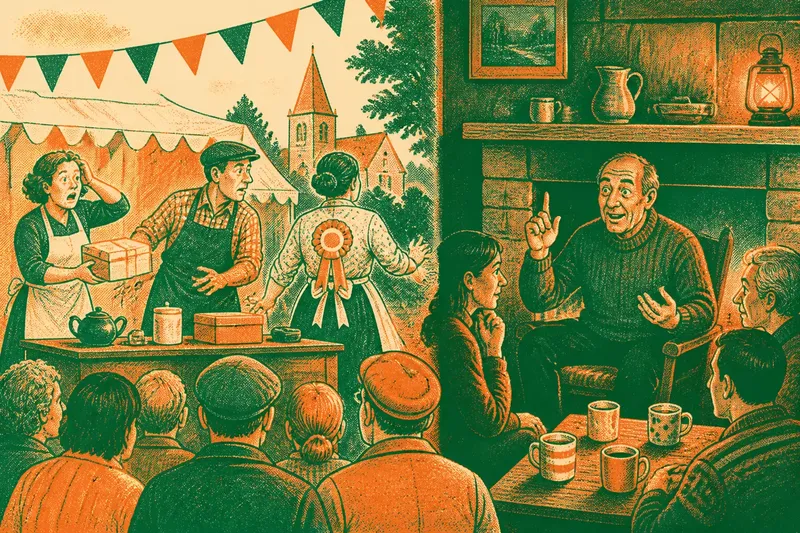
Should a village joke be acted out or told beside the fire? Village fete farce and fireside anecdote can share the same comic misunderstanding, yet each makes an audience laugh in a different way. One turns attention towards bodies, props and timing; the other lets a teller guide listeners through a voice, a pause and a carefully chosen detail.
What separates the forms?
A farce is built to be watched as events collide. A character misses a cue, mistakes a parcel for something else, or tries to hide a muddle while other people keep arriving. The audience can see the growing tangle even when the characters cannot.
An anecdote is built to be heard as a sequence shaped by a teller. The listener follows what happened, but also how the speaker remembers it: which detail comes first, where the voice changes, and when the punchline is allowed to land. A small incident can feel comic because the teller knows exactly what to leave unsaid.
The distinction is not simply public performance versus private conversation. A spoken anecdote can delight a crowded room, while a farce can be staged for a handful of neighbours. The useful question is what carries the joke: visible action or the telling of it.
Choose the form according to where the laugh lives.
How does movement make farce?
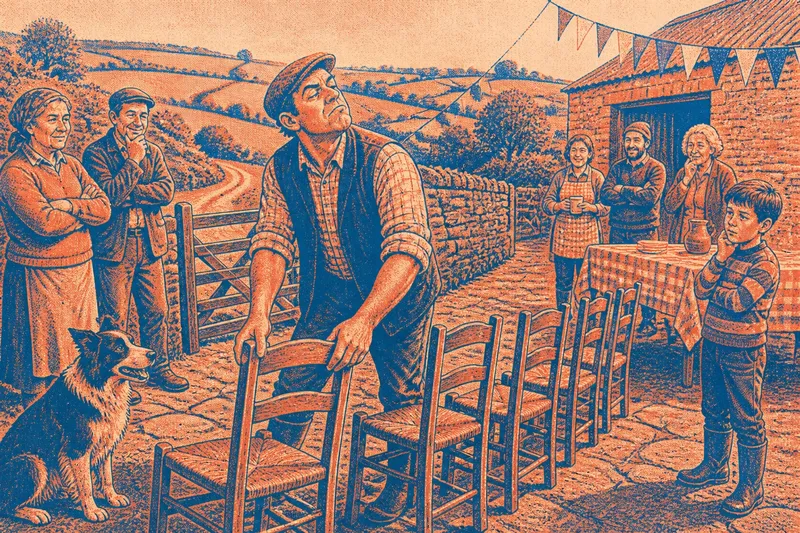
Farce uses bodies moving through shared space. A bench, a trestle table, a bunting line or a box of raffle prizes can become part of the comic machinery. Someone turns to answer one person, blocks another’s route and accidentally sets off the next misunderstanding.
The audience’s attention is spread across the scene. A spectator may notice a character hiding a teapot behind a curtain while another character confidently searches the table. That gap between what the crowd sees and what the characters understand creates anticipation. The laugh may arrive before the concealment fails, or at the instant it does.
Movement also gives a scene a rhythm that words alone cannot supply. A hurried crossing can make a modest problem feel urgent; a frozen pose can hold the room while the audience catches up. Props work best when their purpose is instantly legible. If the joke depends on a complicated object or an unclear entrance, spectators may spend the crucial moment trying to understand the staging.
Keep the action easy to read from the back of the room.
How does a teller shape laughter?
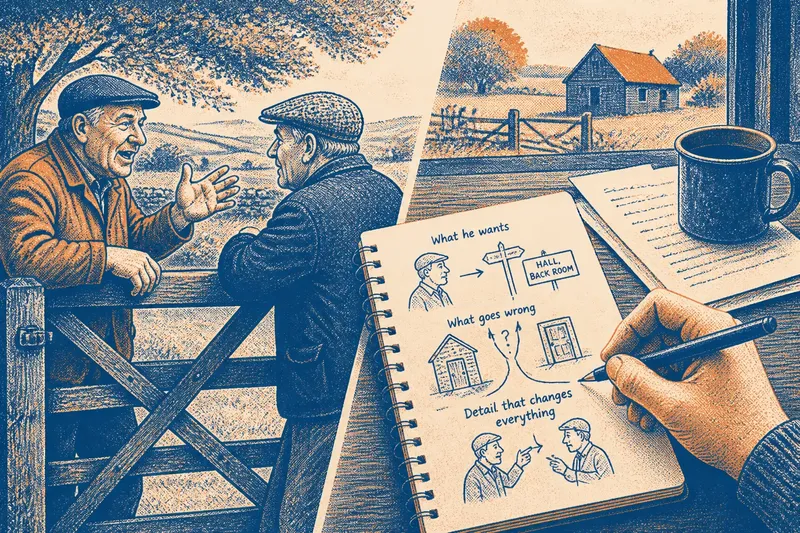
An anecdote concentrates attention on one voice. The teller may speak as themselves, imitate a neighbour, or shift gently between the two. A change in pace can suggest a character’s confidence; a quiet pause can let listeners recognise the absurdity before the final line arrives.
Unlike staged farce, the storyteller can adjust the amount of detail to the listeners in front of them. They might mention the damp coat, the awkward silence or the too-polite reply because those touches make the scene feel socially familiar. But too much explanation can flatten the punchline. The audience needs enough to picture the moment, not a report of every step that led to it.
Voice can also make an anecdote feel affectionate rather than cruel. A teller who includes their own confusion or embarrassment shares the joke instead of placing all the foolishness on someone else. That matters in a small community, where listeners may know the people behind the story.
Let the voice reveal the moment; don’t explain the laugh afterwards.
Which form suits a village gathering?
Use farce when the occasion offers a clear performance space and people can comfortably watch together. A village hall, fete platform or sheltered corner can give performers room to cross, pause and make a prop visible. The format suits jokes that grow through entrances, mistaken identities or a chain of physical consequences.
Use an anecdote when the pleasure lies in a particular voice, a telling detail or the teller’s relationship with the listeners. It can fit a supper table or a quiet pause between other activities without requiring everyone to face a stage. Its intimacy can make a modest incident memorable.
Say a fete committee wants a comic moment about a missing ribbon. If the fun comes from three helpers searching the same table while the ribbon is pinned to one helper’s back, an acted scene lets the audience spot the mistake and wait for discovery. If the amusing part is the organiser’s flustered account of how everyone offered increasingly unlikely explanations, a fireside anecdote gives that voice room to carry the joke. The same starting point can become two distinct pieces, depending on where the comic energy sits.
Match the form to the moment the audience is meant to notice.
How do place and audience change the joke?
Village humour often depends on shared knowledge: who normally runs the tea stall, what the hall cupboard contains, or how a committee meeting tends to drift. A farce can turn those familiar objects and habits into visible clues. An anecdote can rely on listeners recognising the social rhythm behind a well-placed remark.
That familiarity is a resource, not a licence to make a real person the target. If a comic character resembles a neighbour, give them a recognisable motive and room to recover dignity. A muddled plan, a proud claim or a harmless misunderstanding usually offers more comic possibility than a private vulnerability.
Consider who can follow the joke. A scene may need a spoken cue for spectators who cannot see a small prop; an anecdote may need one brief piece of context for listeners new to the place. The aim is not to explain local life in full, but to make the comic turn clear without shutting anyone out.
What do readers ask most?
Can one joke work in both forms?
Yes, if you reshape how the audience receives it. A visual reveal needs staging and sightlines in farce, while an anecdote needs a teller’s sequence, voice and timing to make the same reveal vivid in speech.
Does farce need a large cast?
No; a small group can create a lively tangle through clear roles and purposeful movement. The audience must be able to tell who knows what and why each entrance or interruption matters.
Can an anecdote be rehearsed?
It can be practised without making it sound stiff. A teller can polish the order of events and find a natural pause, while leaving room for the conversational quality that makes listeners feel included.
How can a joke stay kind?
Give the person at its centre a recognisable human motive, and direct the laugh towards the muddle rather than a personal hardship. In a close-knit audience, fictionalising identifying details can also keep a familiar story from becoming uncomfortable.
What lasts after the laugh?
Farce leaves an image: a crowded doorway, a misplaced parcel or a character caught in a pose they cannot explain. Anecdote leaves a voice in the ear, along with the sense that a familiar incident has been turned over until its comic edge appears. Neither form is automatically livelier; each asks the audience to pay attention in a different way.
When choosing between village fete farce and fireside anecdote, start with the detail that makes you smile. If it needs to be seen, give it space to move. If it depends on how someone tells it, let the voice lead—and stop before the explanation outlasts the laugh.